The Athlete's Dilemma: Productive Discomfort or a Setback?
Every athlete, from the weekend runner in Solihull to the dedicated sports professional, has been there. You’re in the middle of a workout or a rehabilitation exercise, and you feel a twinge. Immediately, your mind starts racing: Is this the 'good pain' of a muscle getting stronger, or is it a warning sign that you’re about to re-injure yourself? This uncertainty can be paralyzing, turning your recovery journey into a guessing game. Pushing through the wrong kind of pain can lead to significant setbacks, while being overly cautious can stall your progress. Understanding the difference is the first crucial step toward a safe and effective comeback.

Understanding 'Good Pain': The Feeling of Progress
Not all discomfort is a red flag. In fact, some types of pain are positive indicators that your body is adapting and growing stronger. This is what we call 'good pain' or productive discomfort. The most common example is Delayed Onset Muscle Soreness (DOMS), that familiar, generalized ache you feel in your muscles 24 to 48 hours after a tough workout or a new exercise. This pain is typically dull, achy, and spread over a whole muscle group rather than being focused on a single, sharp point. During rehabilitation, 'good pain' can also feel like muscle fatigue or a deep stretch while performing a prescribed exercise. It’s the sensation of challenging your tissues to heal and rebuild, a sign that you are on the right track to recovery and improved performance.
Recognizing 'Bad Pain': Your Body's Warning Signs
In contrast, 'bad pain' is your body’s way of screaming “Stop!” This is the pain that signals potential tissue damage and should never be ignored. Learning to recognize its characteristics is vital for preventing further injury. Be on high alert for:
- **Sharp, stabbing, or shooting pain:** This type of sensation is often localized to a specific spot and indicates acute stress on a joint, ligament, or nerve.
- **Pain that increases during activity:** While good pain might fade as you warm up, bad pain tends to worsen the more you push.
- **Pain accompanied by swelling, numbness, or tingling:** These are serious red flags that point towards inflammation or nerve impingement.
- **Pain that forces you to change your form:** If you find yourself limping or altering your technique to avoid a certain pain, you are creating dangerous compensation patterns.
Ignoring these signals is a fast track to a longer, more complicated recovery. It is always better to stop and assess than to push through and cause more harm.
The Traffic Light System: A Simple Guide for Self-Assessment
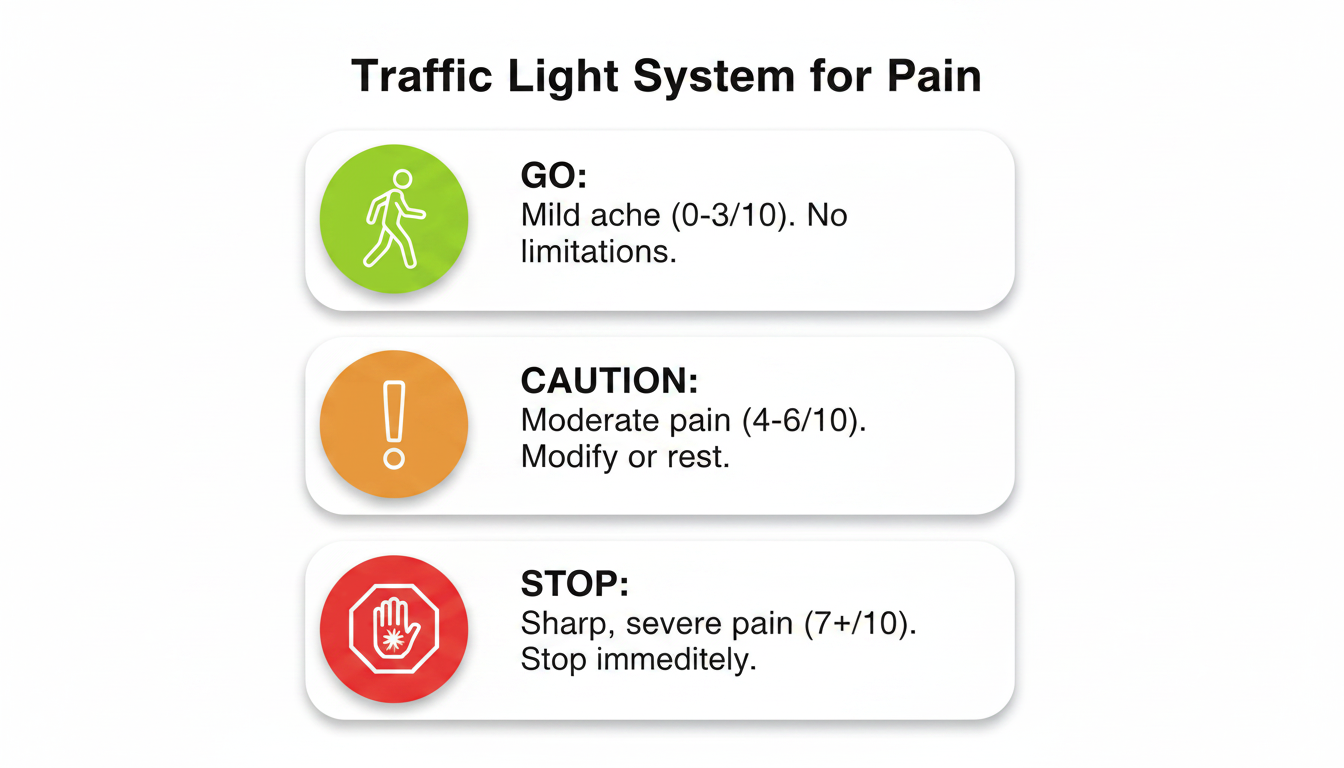
To make quick, smart decisions during your activity, you can use a simple mental model: the Traffic Light System. This tool helps you categorize your pain and react appropriately, taking the guesswork out of your training and rehab.
- **GREEN LIGHT:** You may feel a mild, dull ache or general muscle fatigue (a 0-3 on a pain scale of 10). The discomfort doesn't increase as you move and doesn't affect your form. You are in a safe zone and can **continue your activity** with confidence.
- **AMBER LIGHT:** You feel a more distinct, moderate pain (a 4-6 on the pain scale). It's more than a simple ache, and you are constantly aware of it. It might cause you to hesitate or feel slightly cautious. This is a clear signal to **modify the activity or stop**. Reduce the intensity, check your form, or switch to a different exercise.
- **RED LIGHT:** You are experiencing sharp, stabbing, or radiating pain (a 7 or higher on the pain scale). The pain is severe, might be increasing, and could be affecting your ability to move correctly. This is an absolute **STOP**. Do not push through. Rest, apply ice if appropriate, and seek professional advice.
From Guesswork to Guidance: Your Clear Path to Recovery
Listening to your body is a powerful skill, but interpreting its signals during injury recovery can be complex and stressful. While the Traffic Light System is an excellent guide for in-the-moment decisions, it doesn't replace the value of expert, professional insight. A physiotherapist can accurately diagnose the root cause of your pain, distinguishing between productive soreness and a true injury. Instead of navigating the uncertainty alone, let an expert provide a clear, objective roadmap. We can help you understand exactly what your body is telling you, ensuring you recover effectively, prevent re-injury, and get back to peak performance with confidence. If you're tired of the guesswork and ready for a clear plan, book your initial assessment with us today.